| ◈ Project Overview |
🔥 Status of Project Available for Transfer:STC1 Monoclonal Antibody 🏷️ Platform Project Number:PG0003 📅 Listed Date:April 2026 📊 Current Stage:In vitro and in vivo validation completed ⭐ Project Evaluation:The STC1 Monoclonal Antibody (PG0003) has undergone biochemical affinity validation, cellular-level affinity validation, and mouse in vivo testing, demonstrating high potential for drug development. Contact us for more information.Contact us for more information. |
| ◈ Background Introduction |
STC1 (stanniocalcin 1) is a highly conserved secreted glycoprotein hormone in vertebrates. The human STC1 gene encodes a 247-amino-acid precursor polypeptide whose primary translation product contains a signal peptide; after maturation, it functions as a soluble secreted protein. Previous studies have shown that STC1 is predominantly α-helical in structure and forms a stable homodimer through disulfide bonds. As a hormone homolog originally identified in bony fish and associated with calcium and phosphate homeostasis, STC1 in mammals is no longer regarded as a molecule confined to a single endocrine function, but rather as a broadly expressed paracrine or autocrine regulatory factor.
From a biological perspective, STC1 exerts multiple functions, including metabolic regulation, stress response, and maintenance of microenvironmental homeostasis. STC1 participates in mitochondria-related regulatory processes and suppresses the accumulation of reactive oxygen species, thereby conferring antioxidant, anti-inflammatory, and cytoprotective effects. In addition, STC1 also plays important roles in tissue repair, inflammatory regulation, maintenance of vascular homeostasis, and functional regulation of the reproductive system.
In disease-related research, the association between STC1 and tumor progression has attracted particular attention. STC1 is aberrantly expressed in multiple tumor types and is associated with tumor cell proliferation, migration, invasion, angiogenesis, and poor prognosis. In breast cancer, for example, tumor-secreted STC1 enhances the invasive capacity of tumor cells and promotes angiogenesis and fibroblast activation within the metastatic microenvironment, thereby facilitating lung metastasis. Beyond its direct involvement in tumor progression, STC1 also participates in the regulation of the tumor microenvironment, demonstrating broader functional versatility than that of a typical secreted factor.
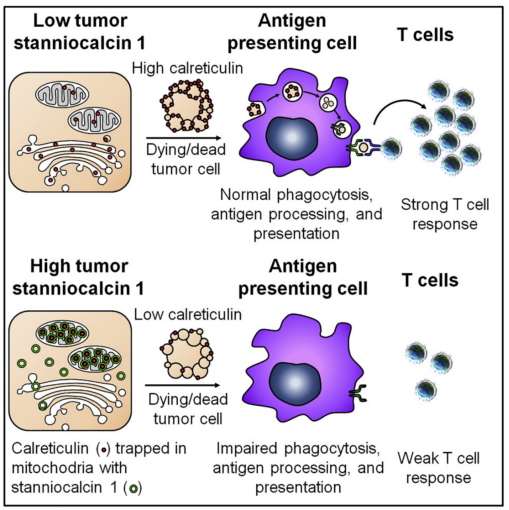
STC1 has also emerged as a novel phagocytosis checkpoint molecule of interest in tumor immunity. Tumor-derived STC1 can modulate calreticulin-related phagocytic signaling, thereby weakening the phagocytosis of tumor cells by antigen-presenting cells and the subsequent process of immune activation, ultimately promoting tumor immune evasion and contributing to resistance to immunotherapy. Because STC1 links multiple key processes, including cytoprotection, microenvironmental regulation, tumor progression, and immune escape, it represents an antibody intervention target with strong mechanistic relevance and broad application potential.
Based on the clear molecular mechanisms and biological evidence described above, the anti-STC1 antibody program has strong scientific rationale and differentiated development potential. Our company can provide anti-STC1 antibody products to support basic research and translational applications.
References:
[1] Lin H, Kryczek I, Li S, Green MD, Ali A, Hamasha R, Wei S, Vatan L, Szeliga W, Grove S, Li X, Li J, Wang W, Yan Y, Choi JE, Li G, Bian Y, Xu Y, Zhou J, Yu J, Xia H, Wang W, Alva A, Chinnaiyan AM, Cieslik M, Zou W. Stanniocalcin 1 is a phagocytosis checkpoint driving tumor immune resistance. Cancer Cell. 2021 Apr 12;39(4):480-493.e6. doi: 10.1016/j.ccell.2020.12.023. Epub 2021 Jan 28. PMID: 33513345; PMCID: PMC8044011.