| ◈ Project Overview |
🔥 Status of Project Available for Transfer:CXCL12 Monoclonal Antibody 🏷️ Platform Project Number:PG0002 📅 Listed Date:April 2026 📊 Current Stage:In vitro and in vivo validation completed ⭐ Project Evaluation: The CXCL12 (PG0002) Monoclonal Antibody has undergone biochemical affinity validation, cellular-level affinity validation, and mouse in vivo testing, demonstrating high potential for drug development. Contact us for more information. Contact us for more information. |
| ◈ Background Introduction |
CXCL12 (C-X-C motif chemokine ligand 12), also known as stromal cell-derived factor 1 (SDF-1), is a homeostatic member of the CXC chemokine family and functions as a secreted small cytokine. The human CXCL12 gene undergoes alternative splicing to generate multiple isoforms, among which CXCL12α is the most common canonical form. Its primary translation product contains a signal peptide, and the mature protein exerts its function as a soluble chemokine. The canonical receptor for CXCL12 is CXCR4, and it can also functionally interact with the atypical chemokine receptor ACKR3/CXCR7, thereby inducing intracellular calcium flux, chemotactic migration, and activation of multiple downstream signaling pathways, including PI3K/AKT, MAPK/ERK, and JAK/STAT. Under physiological conditions, CXCL12 plays essential roles in embryonic development, hematopoietic stem/progenitor cell homing, immune cell trafficking, inflammatory regulation, and the maintenance of tissue homeostasis, making it one of the central chemokines linking cell motility to microenvironmental regulation.
During tumor initiation and progression, aberrant activation of CXCL12 signaling is not merely associated with enhanced migratory signaling, but rather is involved across multiple critical stages of tumor development, including proliferation, vascular remodeling, metastasis, and the acquisition of therapeutic resistance. The CXCL12-CXCR4/CXCR7 axis can directly promote tumor cell proliferation, survival, migration, and invasion, and is closely associated with angiogenesis, epithelial-mesenchymal transition, metastatic dissemination, and treatment tolerance. In addition, CXCL12 can be continuously secreted by stromal components such as cancer-associated fibroblasts, thereby establishing chemotactic gradients and a protective microenvironment that favor tumor progression and confer advantages to tumor cells during both local growth and distant colonization.
CXCL12 also plays an important role in promoting the formation of an immunosuppressive tumor microenvironment. CXCL12 derived from cancer-associated fibroblasts (CAFs) contributes to the establishment of a stromal immune barrier, restricts the infiltration of effector T cells into the tumor parenchyma, and is associated with immune evasion as well as poor responsiveness to immunotherapy. In preclinical and early clinical studies, inhibition of CXCL12 signaling has been shown to increase tumor-infiltrating lymphocytes and to exhibit synergistic potential when combined with PD-1 blockade. These findings indicate that CXCL12 is not only a target of tumor biology, but also a promising target for tumor immune regulation.
Based on the clear molecular mechanisms and tumor immunological evidence described above, the anti-CXCL12 antibody program possesses strong scientific rationale and differentiated development potential. Our company can provide anti-CXCL12 antibody products to support basic research and translational application needs.
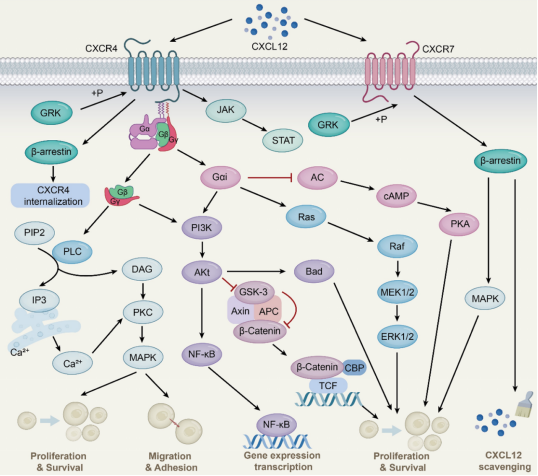
References:
[1] Yang Y, Li J, Lei W, Wang H, Ni Y, Liu Y, Yan H, Tian Y, Wang Z, Yang Z, Yang S, Yang Y, Wang Q. CXCL12-CXCR4/CXCR7 Axis in Cancer: from Mechanisms to Clinical Applications. Int J Biol Sci. 2023 Jun 26;19(11):3341-3359. doi: 10.7150/ijbs.82317. PMID: 37497001; PMCID: PMC10367567.